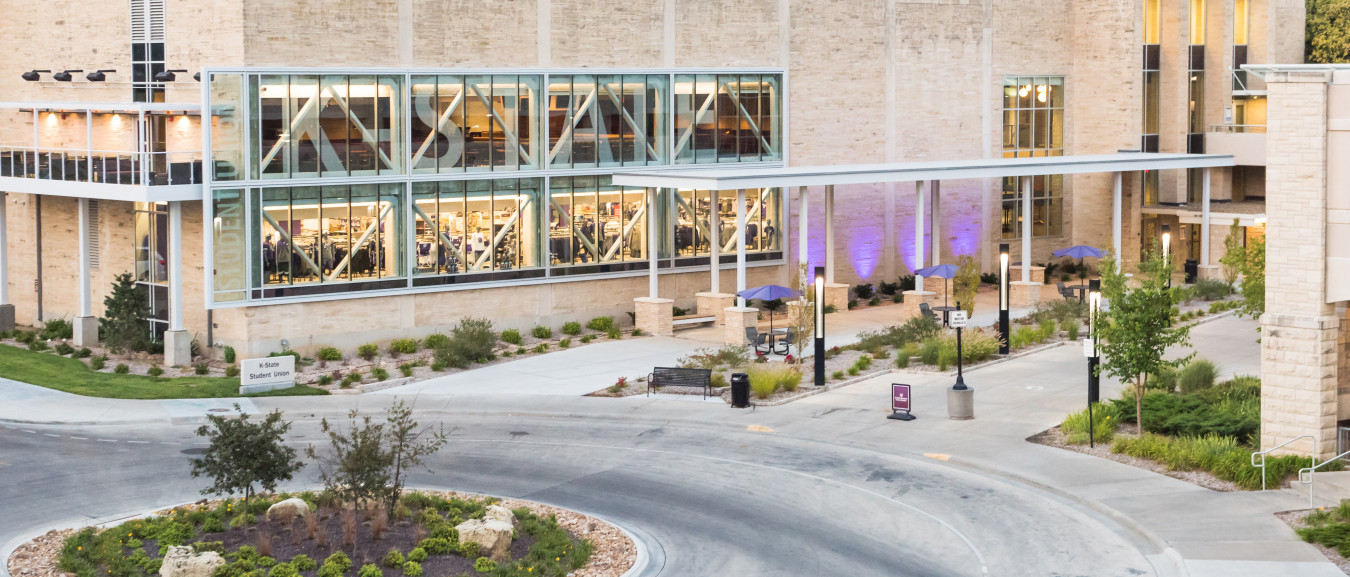
Art Exhibits & Galleries
The Union has a rich history of private art. Since its inception, the Union has been acquiring artwork to add to its permanent art collection on display throughout the building.
Along with the major displays and the William T. Kemper Art Gallery, the Union houses many other beautiful, though less well-known, pieces of artwork. Prior to its relocation to the Marianna Kistler Beach Museum of Art, the Union was home to the extensive University Art Collection.
The next time you’re at the Union, take a moment to explore some of these incredible art exhibits.
William T. Kemper Art Gallery
The William T. Kemper Art Gallery, scheduled by the Union Program Council, is the premier venue for art exhibits, showcasing K-State students, faculty, and guest artists all year round.
Originally called the Art Lounge, today's gallery remains in the same room as it was in 1956. A contribution from the William T. Kemper Foundation in December 2000 facilitated the renovation of the 1,069 square-foot space.
The William T. Kemper Art Gallery is located by the first floor east entrance.
Moments and Years Exhibit now open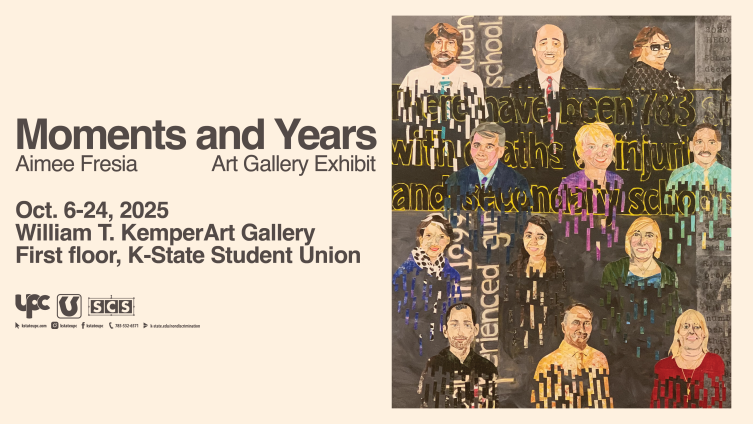
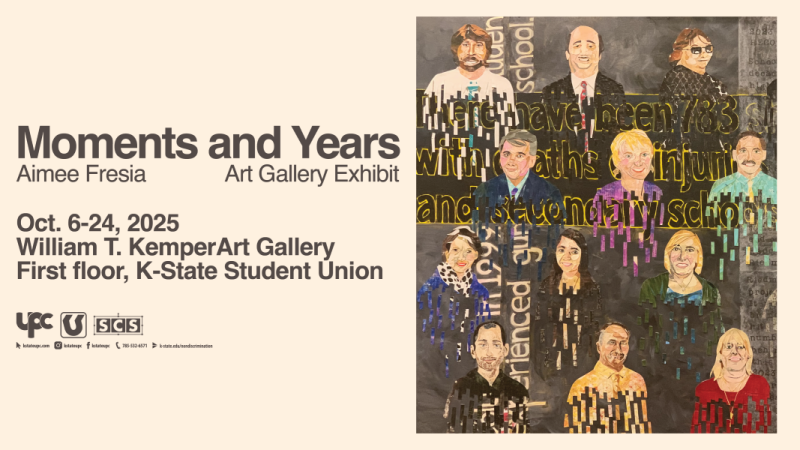
MANHATTAN, KS — The new exhibit at the William T. Kemper Art Gallery invites the campus and local community to come check out the "Moments and Years" art exhibit by Aimee Fresia.
"Moments and Years" runs through Oct. 24 in the gallery located on the Union’s first floor.
For more information, contact UPC at upc@k-state.edu or visit the UPC event page here.
Past Exhibits
2025
- The Things We Keep
- 50th Anniversary Student Photography Contest Winners Announced
- UPC Opens 50th Annual Student Photography Contest
- Textures and Depth: Unveiling Perspectives and Identities
2024
- KSUnite Community Portrait
- Melanie Yazzie: Calling for Rain Art Exhibit
- "Unseen Artist" Exhibit: Aaron Stefan, MFA
- "What Were You Wearing?" Art Exhibit
- Student Photography Contest
- Spectrum of Black Beauty Art Exhibit
2023
2022
- A Splash of Color with BoxHead Arts
- Spoonies and Drifters
- A Thousand Words
- Colombian Artist Group
- Life Through My Eyes Art Exhibit
2021
Chinese Warrior Exhibit
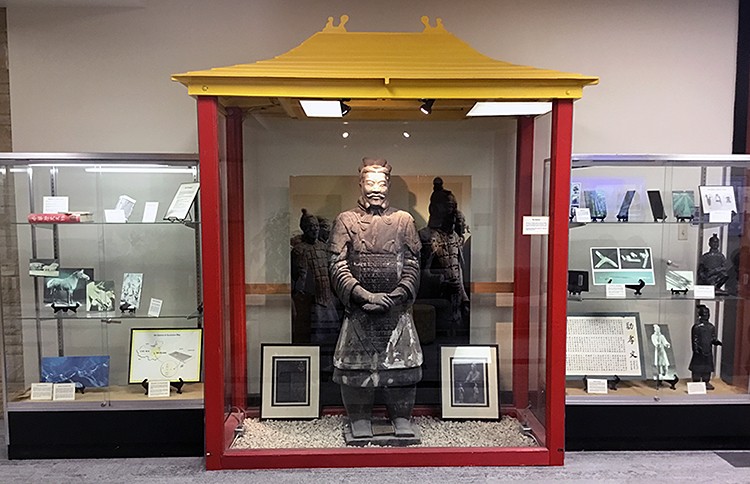
The Union received an impressive addition to its permanent art collection in 2001. The Norman Brandeberry family graciously donated a rare replica sculpture of an ancient Chinese warrior, which dates back to the Qin Shi Huang dynasty (259-210 BC).
In 1974, archaeologists working in China uncovered one of the major discoveries of the century — the attendant burial pits of Qin Shi Huang, China’s first feudal emperor. More than 8,000 unique, life-sized, armored Terra Cotta warriors and more than 100 chariots were found in a rectangular military formation.
Part of China’s national treasury and considered the “Eighth Wonder of the World,” a limited number of replicas have been authorized and created for private collections. The Union’s statue is number 14 and is the focus of a special exhibit that also includes materials developed by history professor David Graff.
The statue was officially dedicated in 2002 as part of the Union Program Council’s Festival of Nations.
The Chinese Warrior Exhibit is located on the second floor.
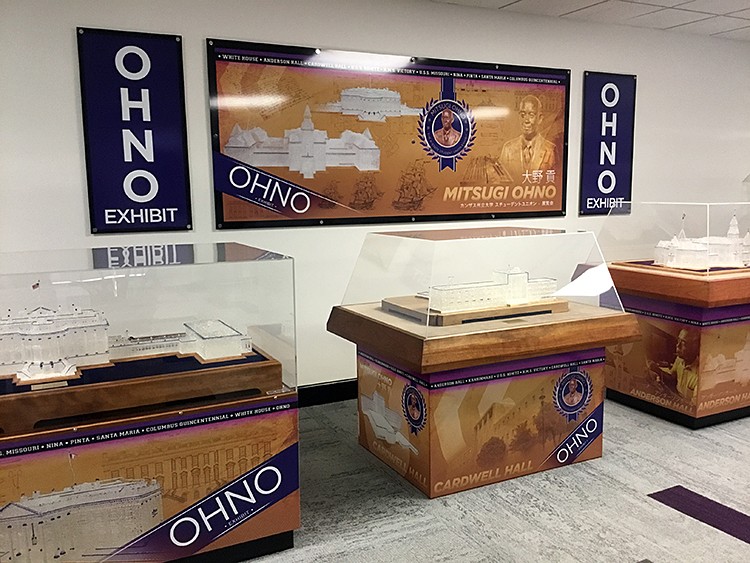
Ohno Blown Glass Exhibit
Born in Bato-machi, Japan, Mitsugi Ohno began his career as a glassblower in 1947 at the University of Tokyo’s Department of Chemistry. He joined Kansas State University in 1961 and retired as Senior Master Glassblower in June 1996.
Professor Ohno achieved national and international recognition for his highly prized and artistic glass creations. His unique glass vessels, art objects, and replicas of famous buildings and ships have been donated to and displayed in prestigious locations such as the Smithsonian Institution, the White House, the Imperial Palace of Japan, the National Archives, the Eisenhower Presidential Library and Kansas State University. He is the author of 12 monographs, textbooks and papers and has been honored with several awards and citations, including the State of Kansas Governor’s Special Lifetime Arts Recognition Award, the Yoshikawa Eiji Prize for Cultural Merit and the Fifth Order of Merit, Order of the Rising Sun, Gold and Silver Rays — a very special honor from the Emperor of Japan.
In addition to the replicas of Anderson Hall, Cardwell Hall, the U.S.S. Nimitz, the U.S.S. Missouri, and the White House, which are all displayed in the Union, there are a number of historic glass ship models on display including the Nina, Pinta and Santa Maria, the Mayflower, the U.S.S. Constitution and the H.M.S. Victory.
Mitsugi Ohno died on October 22, 1999, having nearly completed his last model of the Japanese sailing vessel, Kanrin Maru, which is in the display case that includes his bust and other personal items.
The Ohno Blown Glass exhibit is located on the second floor.